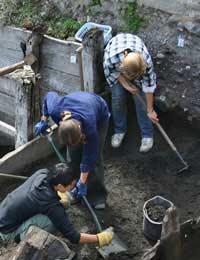
Work alongside historians and professional archaeologists on projects including archaeological site excavation rock art exploration and restoration, ground survey, archival research, or historic structure and architectural restoration. Archaeological volunteers have helped stabilize early cliff dwellings in New Mexico; excavated Solomon’s palace on the tel at Megiddo, Israel; and uncovered the lost world under the Coliseum at Rome.
An archaeological vocation generally involves many years of in-depth study and countless days digging in excavation pits, often under severe, harsh, and hot conditions. However, many people are opting for an archaeological ‘vacation’ as a short-term volunteer. This can be a great way to experience genuine archaeology, share your budding skills, see and stay in a foreign country with like-minded enthusiasts, and more importantly, interact with professional archaeological experts.
Simply turning up and jumping into an excavation pit is not the best way to start your volunteer stint as an archaeologist. There are a number of matters to consider if you are thinking about joining a dig as a volunteer archaeologist.
General Health and Fitness
As most archaeological volunteer programmes are located in dry, barren places, the work conditions are often quite demanding. To minimise exposure to stifling mid-day heat the digging day can begin as early as 4am. Prolonged exposure to heat and direct sun can be debilitating and exhausting. The volunteer may be required to push loaded wheelbarrows of soil or repetitively carry full buckets of dirt over long distances. Such work is demanding and necessitates a good level of general health. See your doctor before going if you are at all unsure.
What Will You Do?
Naturally, as a novice, you will not be leading the excavation as the site supervisor. Instead, the work of the volunteer is usually labour orientated and always in conjunction with others, usually archaeology students from the host university operating the dig.
If you arrived at the beginning of the digging season you will be involved in site preparation, which includes restringing the squares and baulks, clearing out any debris deposited since the last season, and erecting shade covers over the digging pits.
Once the preliminaries are attended to, you will be assigned to a site supervisor who will place you with a small team. Regular digging tasks can include using all of the archaeological tools from hefty picks to tiny trowels as you are coached through the day by a senior student in your group.
Most university-hosted excavations will provide lectures in the evening from their academic staff. They are usually free to sit in on and listen to, but there will be a fee if you wish to receive academic credit for them.
Will I Find Gold and Treasure?
No one can predict what artefacts an archaeological site will yield. The most common items recovered from a dig are potsherds (pieces of broken pottery). They may range in size from a fragment as small as a fingernail to a chunk the size of your hand. No matter how great or small the find there is always a heart-thumping thrill as the trowel ‘tinks’ on the ceramic sherd and the accompanying excitement of its slow and careful disclosure.
All artefacts are cleaned and examined by specialists in the field, often on the same day and usually in the late afternoon when conditions are cooler. It is at these briefing seminars that you will be told the history and background to your finds. Should your artefact prove to be a valuable addition to the expeditions work, it might even be named after you. Less important pieces will be catalogued and archived. The dig supervisor may permit volunteers to keep very common items such as some potsherds or flint artefacts as a souvenir of their participation.
How to Join a Dig
There are many opportunities to volunteer on an archaeological dig. Almost every university-hosted site throughout the world permits novice enthusiasts to join their digging programmes.
Not all universities have an archaeology department and even fewer actually run regular excavations but any large university will be able to provide the names of those that do. Speak to the archaeology or anthropology department to enquire about volunteer placements.
What Experience is Needed?
Lack of experience is not as important as you might think. Much of the volunteer’s input is just ‘being there’ in a practical way to help complete or continue a project where funding is limited. You may think that lifting up and removing an ancient mosaic from a Roman bath-house in Greece and cleaning then restoring the surface, chipped by falling columns and roof tiles, might be the job only for restoration specialists and in part you are right. It certainly takes a specialist to set out the strategy for the restoration programme but once the project is underway, a great deal of non-experts become involved. Indeed, semi-skilled labour is paramount to success.
It doesn’t cost anything to participate in most archaeological volunteer projects but you do have to get yourself to the excavation site and more often than not you have to pay for your own food and accommodation while there. These are normally provided at a reasonable rate to volunteers.